

Jackie Cochran
World Class Aviator
Champion of Women Pilots
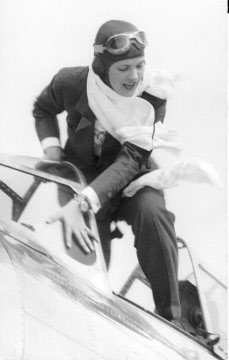
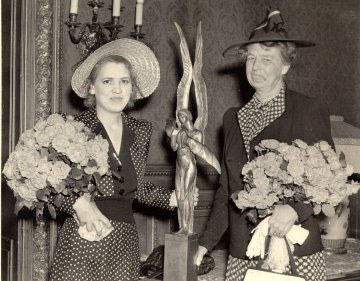
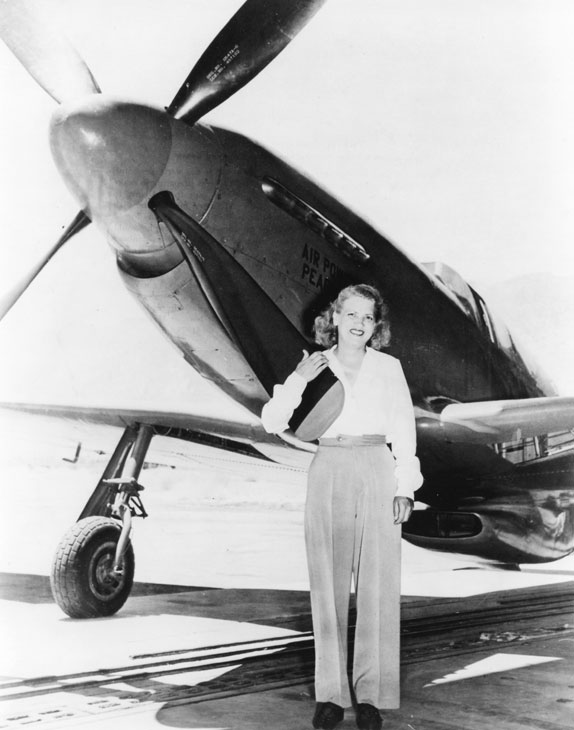
Jackie Cochran overcame many challenges to become an accomplished aviator. She set three major flying records in 1937 and was the first woman to win the prestigious transcontinental Bendix Race the following year. Over her life she won the coveted Harmon trophy 14 times, the first presented to her by First Lady Eleanor Roosevelt.
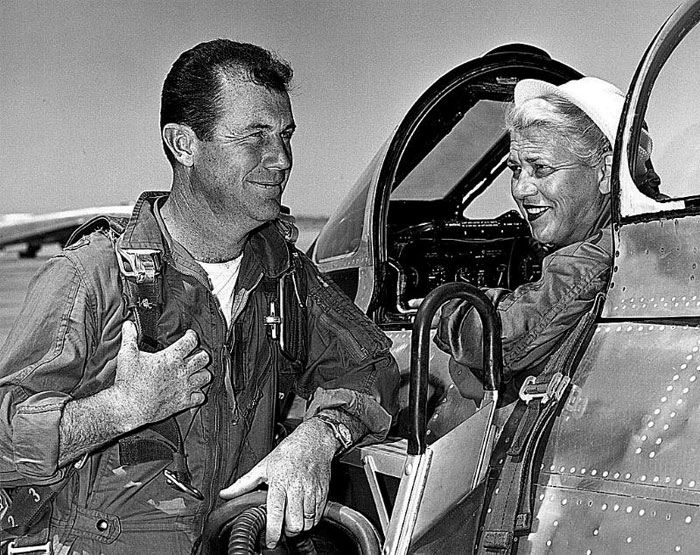
Always eager for new challenges, Jackie Cochran broke many barriers for women pilots. On June 17, 1941, she became the first woman pilot to fly a military bomber across the Atlantic Ocean. In 1953, Jackie Cochran was the first woman pilot to break the sound barrier flying an F-86 Sabre Jet, following in the footsteps of her good friend Chuck Yeager, the man who first flew faster than the speed of sound. In 1964, she set a world speed record of 1,429 mph in 1964. At the time of her death in 1980, she held more speed, altitude and distance records than any other male or female pilot did in aviation history.
Jacqueline Cochran broke other barriers as well---barriers to women serving as military pilots in the United States. She first wrote to First Lady Eleanor Roosevelt in 1939 recommending that women pilots be used in the armed forces. At the request of President Roosevelt, Jackie Cochran prepared a report in July 1941 on “Organization of a Woman Pilots’ Division of the Air Corps Ferrying Command.” Despite this interest in the White House, Jackie Cochran discovered what Nancy Love had the year before: the Army simply wasn’t ready for such bold ideas.
When news of her successful flight in a military bomber across the Atlantic Ocean in 1941 reached President and Mrs. Roosevelt, they invited Jackie Cochran to lunch at Hyde Park. This set into motion a series of talks with military personal where she devised a plan for training women in military aircraft. It is rejected. Nonplussed, she continues to press until General Henry “Hap” Arnold, Commanding General of the Army Air Forces hears her out. Not convinced, he turns her down but suggests she assist the British Air Transport Auxiliary to ferry its planes in England to prove what women pilots can do.
Cochran recruits twenty five other American women pilots to ferry planes for the British Air Transport Auxiliary with the strict proviso that if she was needed at home, she will be released from her duties. In September 1942, General Hap Arnold establishes the training program for women pilots known as the Army Air Force Women’s Flying Training Detachment (WFTD) and appoints Jackie Cochran as the director.
Jackie Cochran intended that this program would train women pilots “the Army way.” The training for any woman pilot in the WFTD would be exactly what was required of the men in the Army Air Forces. The WFTD merged with the WAFS in 1943 to become the Women Airforce Service Pilots (WASP). The waiting list to become a WASP was long and the competition was fierce. Over 25,000 young women applied to become a WASP, but only 1830 were selected for the training program and only 1074 of them graduated.
The requirements to enter the WASP training program were not as stringent as those required by WAFS. With the first class began in November 1942, the trainee was required to have had 200 pilot hours, the same requirement as men. By 1943, however, only 35 previous flight hours were required to apply.
Unlike the male Army Air Force Cadet, a WASP trainee was expected to pay her way to flight school, pay for their room and board while there, pay for their uniforms, and if killed in the line of duty, no military funeral, no right to use the American flag on the coffin, and no military escort home.
There was a push to get the WASP program militarized so that these women who served our country would no longer serve as civilians, but it reached Congress in 1944 when the need for pilots decreased. WASP Program was deactivated in December 1944
As part of her final report on the WASP, Jackie Cochran noted that if needed in the future, a program of WASP could generate “many scores of thousands of good dependable pilots could be built up in the case of need from the nearly 13,000,000 young women of our country between the ages of 18 and 28, about 6,000,000 of whom are single.” In her graduation speech to the last WASP class, Jackie Cochran said I’m very happy that we’ve trained a thousand women to fly the Army way. . . I think it’s going to mean more to aviation than anyone realizes.”
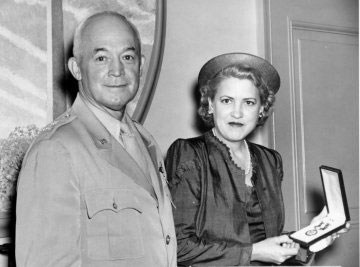
On May 21, 1945, General Arnold presented the Distinguished Service Award to Jacqueline Cochran for her services to the country in directing the WASP.
1940's -- Jackie Cochran standing on the wing of her F-86 whilst talking to Chuck Yeager and Canadair's chief test pilot Bill Longhurst. (Photo courtesy Air Force Flight Test Center History Office
1940's -- Jackie Cochran in the cockpit of the Canadair F-86 with Chuck Yeager. (Photo courtesy Air Force Flight Test Center History Office)
1950's -- Jackie Cochran and Chuck Yeager being presented with the Harmon International Trophies by President Dwight D. Eisenhower. (Photo courtesy Air Force Flight Test Center History Office)
